Leadership Development for CSRs
Overview
Develop leadership skills and prepare for advancement opportunities within Scott Recycling's customer service team.
Lesson 1: Leadership Fundamentals
What is Leadership?
Leadership is influencing others to achieve common goals through: - Clear communication - Leading by example - Supporting team success - Taking initiative - Problem-solving
Leadership vs. Management
| Leadership | Management |
|---|---|
| Inspires and motivates | Plans and organizes |
| Focuses on people | Focuses on processes |
| Sets vision | Implements vision |
| Develops potential | Maintains standards |
| Builds relationships | Manages tasks |
You can be a leader WITHOUT a management title!
Core Leadership Qualities
- Integrity: Do what you say, say what you mean
- Accountability: Own your mistakes, learn from them
- Communication: Clear, honest, timely
- Empathy: Understand others' perspectives
- Initiative: See needs and act
- Adaptability: Embrace change positively
Lesson 2: Team Collaboration & Mentoring
Being a Team Player
Collaboration Skills: - Share information openly - Help colleagues without being asked - Admit when you need help - Celebrate team successes - Support during challenges
Toxic Behaviors to Avoid: - Gossiping or complaining - Withholding information - Taking credit for others' work - Blaming teammates - Negative attitude
Mentoring New Team Members
Your Role as Informal Mentor: - Answer questions patiently - Share your experience - Demonstrate best practices - Provide constructive feedback - Be approachable
Effective Mentoring: - Show, don't just tell - Explain the "why" behind procedures - Let them try (with safety net) - Check in regularly - Celebrate their progress
Lesson 3: Decision Making & Problem Solving
Critical Thinking Framework
The 5 Whys: Ask "why" five times to get to root cause
Example: 1. Why is customer upset? → Missed pickup 2. Why was pickup missed? → Not on schedule 3. Why wasn't it scheduled? → Request not logged 4. Why wasn't it logged? → Phone message missed 5. Why was message missed? → No system for callbacks
Root cause: Need better callback tracking system
Decision-Making Process
- Define the problem clearly
- Gather relevant information
- Identify options
- Evaluate pros/cons
- Make the decision
- Take action
- Review results
When to Escalate vs. Decide
You Can Decide: - Standard procedures - Within your authority - Low risk/impact - You have expertise - Time-sensitive
Escalate When: - Outside procedures - High cost/risk - Affects other departments - Legal/safety concerns - Customer demands manager
Lesson 4: Managing Up & Across
Working with Management
How to "Manage Up": - Bring solutions, not just problems - Communicate proactively - Meet deadlines - Ask for feedback - Understand their priorities
Effective Updates: - Brief and factual - Highlight key issues - Propose solutions - Request specific guidance - Follow up in writing
Cross-Departmental Collaboration
Working with Operations: - Understand their constraints - Give advance notice - Provide complete information - Respect their expertise - Share customer feedback
Working with Sales: - Support their customer relationships - Provide excellent service - Share market insights - Coordinate communications - Celebrate wins together
Lesson 5: Professional Development
Career Advancement at Scott Recycling
Potential Career Path: 1. CSR (Entry Level) 2. Senior CSR (Expert level) 3. Team Lead (Informal leadership) 4. Customer Service Supervisor 5. Customer Service Manager 6. Other departments (Sales, Operations, etc.)
Building Your Skills
Technical Skills:
- Master the queue system — you should be able to work all four queues and the prospect pipeline without hesitation
- Learn the inventory and shipping systems — the more you understand what happens after a pickup, the better you serve customers
- Understand ALL our services: electronics recycling, data destruction, asset management, plastics recycling
- Know our service area, pricing model, and accepted items cold — no hesitation on the phone
- Cross-train: shadow a driver on a pickup route, visit the warehouse to see processing, sit in on an asset management review
- Stay current on e-waste industry news — regulations change, new materials emerge, and customers ask questions
Soft Skills:
- Communication (written & verbal) — your call notes and emails represent the company
- Time management — balancing queue work, inbound calls, and prospect follow-ups
- Conflict resolution — turning angry customers into loyal ones
- Emotional intelligence — reading tone, knowing when to push and when to back off
- Mentoring — helping new team members ramp up faster
Setting Career Goals
SMART Goals Framework: - Specific: Clear and detailed - Measurable: Track progress - Achievable: Realistic - Relevant: Align with career path - Time-bound: Set deadlines
Example Goal: "Complete advanced queue system training and mentor 2 new team members within 6 months to prepare for Team Lead role"
Continuous Learning
Development Opportunities: - Company training programs - Industry webinars - Professional certifications - Reading industry publications - Networking events - Cross-departmental projects
Leadership in Action: Scenarios
Scenario 1: Difficult Teammate
Situation: Coworker consistently shows up late, others must cover
Leadership Response: 1. Speak privately with coworker (maybe personal issue) 2. Offer support if struggling 3. If continues, escalate to supervisor 4. Focus on impact to team, not personal judgment 5. Don't gossip or complain to others
Scenario 2: Process Improvement
Situation: You notice inefficiency in current procedure
Leadership Response: 1. Document the issue clearly 2. Propose specific solution 3. Consider impacts on others 4. Present to supervisor professionally 5. Volunteer to help implement 6. Track results and share success
Scenario 3: Customer Crisis
Situation: Major account threatens to leave over service issue
Leadership Response: 1. Stay calm and professional 2. Listen to all concerns 3. Gather facts quickly 4. Escalate appropriately 5. Follow through on commitments 6. Learn and prevent recurrence
Leadership Self-Assessment
Rate yourself honestly (1-5): - [ ] I take initiative without being asked - [ ] I help teammates succeed - [ ] I communicate clearly and professionally - [ ] I stay positive during challenges - [ ] I accept responsibility for mistakes - [ ] I seek feedback and act on it - [ ] I look for ways to improve processes - [ ] I mentor or support others - [ ] I make good decisions under pressure - [ ] I align my work with company goals
Development Areas: - Scores 1-2: Priority focus - Scores 3: Steady improvement - Scores 4-5: Maintain and model
Action Plan
30-Day Leadership Challenge
Week 1: Mentor someone new Week 2: Propose one process improvement Week 3: Lead a team project or initiative Week 4: Seek feedback from supervisor and peers
Long-Term Development
- Schedule quarterly career conversations with manager
- Identify skill gaps and training needs
- Seek stretch assignments
- Build cross-functional relationships
- Document achievements and growth
Doing This in Odoo
As you grow into leadership, you'll use the system in expanded ways:
Monitoring Team Performance
Supervisors use SR Operations → Team Performance Today to see how the team is doing against targets. Understanding the KPI system helps you coach others effectively.
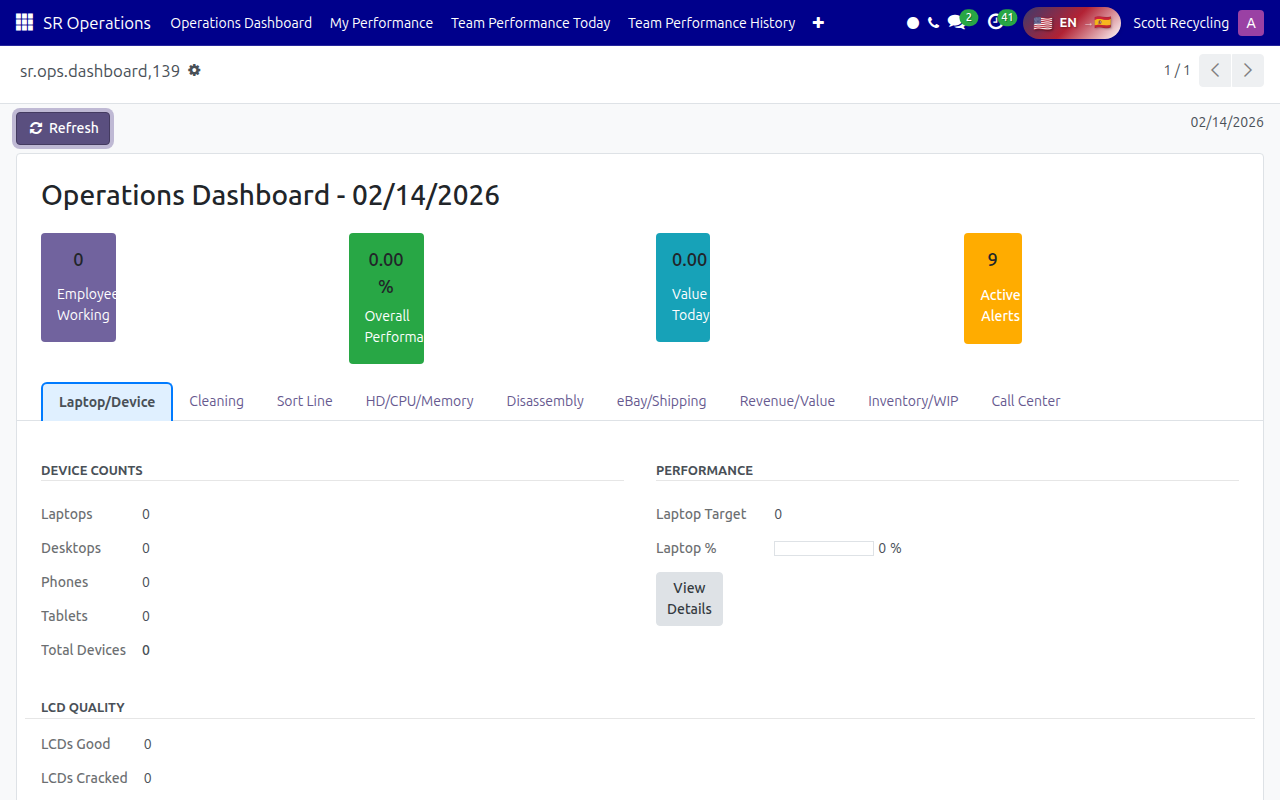
See the KPI Manager Guide for full details on team monitoring.
Leading by Example
The system tracks everyone's KPIs transparently. Consistently hitting your targets and maintaining quality notes in the queue system demonstrates the work habits you want your team to emulate.
Remember: Leadership is a journey, not a destination. Start where you are, use what you have, do what you can!